Free Crochet Plant Hanger Pattern – 2 Sizes – Made by Gootie

Make a sturdy round crochet plant hanger that turns a small pot into an easy wall or window display. This Iris-inspired design begins in a magic ring, builds an open round body with double-crochet clusters, and finishes with four long reinforced hanging loops. The source provides two sizes: a small basket base about 4.5 inches across and a larger base about 6.5 inches across. Both use the same basic idea, so this is an easy project for practicing joined rounds, chain spaces, and even placement around a circle.
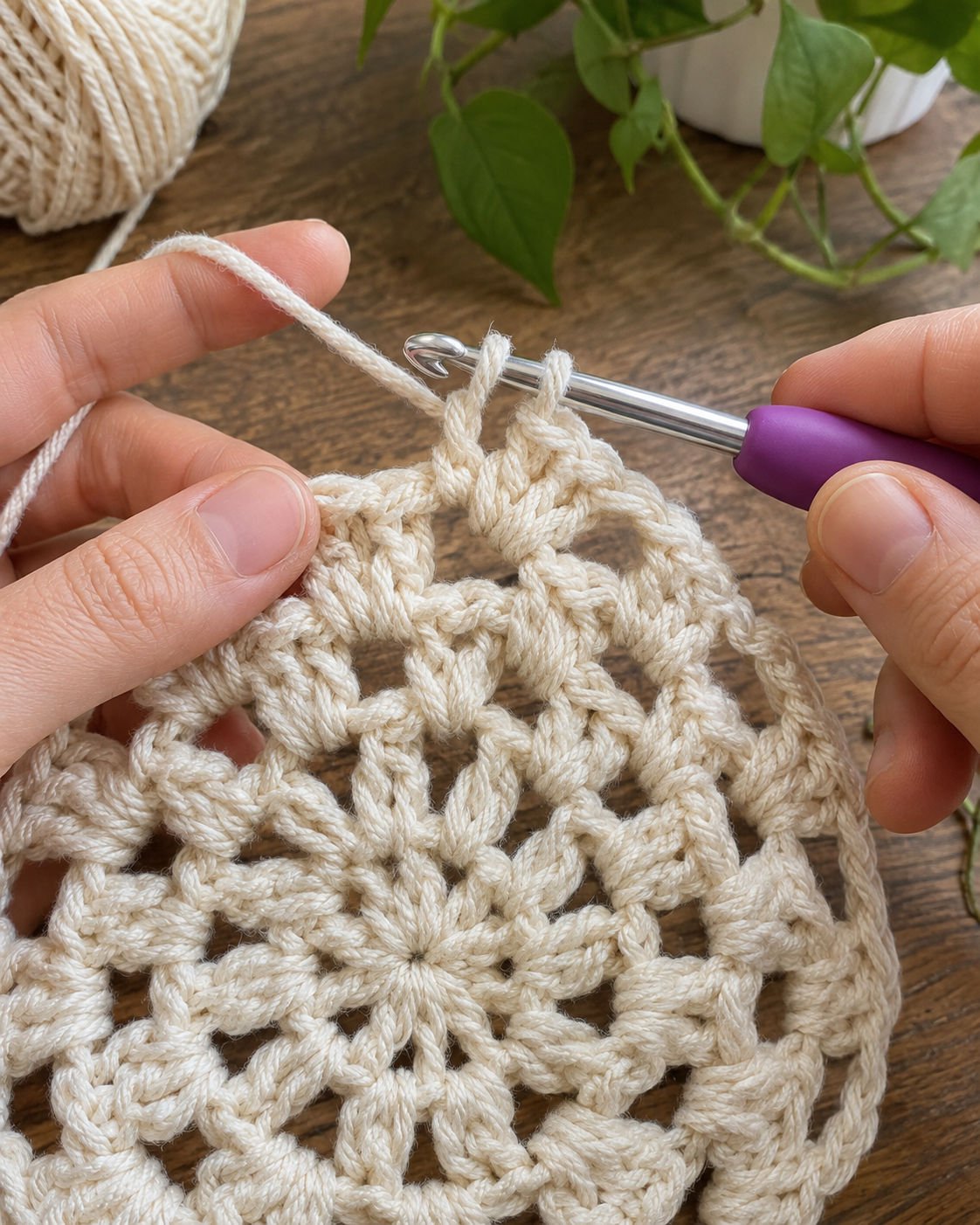
The instructions use US crochet terms. Read through the chosen size before beginning: the larger version continues the same pattern logic after the shared opening rounds, while the small version moves into its side rounds sooner. A firm cotton or high-cotton-blend yarn matters here because a hanger supports weight and should not grow excessively with use. Use a plant pot that sits securely inside the crocheted base, and test the hanger gently before placing a plant in it.
Project Card
-
Project: round, openwork plant hanger with four integrated hanging straps.
-
Skill level: easy.
-
Construction: crochet a circular basket base in joined rounds, build the side height, then form four chained straps and reinforce each strap with slip stitches.
-
Finished base: Small, approximately 4.5 in (11.4 cm); Big, approximately 6.5 in (16.5 cm).
-
Recorded hanger length: approximately 16.5 in (42 cm); total length approximately 19.7 in (50 cm).
-
Gauge reference: Rnds 1–4 with a 4.5 mm hook measure about 4 in (10 cm) across.
Materials and Safety
-
4.5 mm crochet hook.
-
Worsted-weight (#4) cotton yarn. The recorded sample used a recycled cotton/polyester yarn with a high cotton content.
-
Small size: approximately 70 g / 105 m / 115 yd.
-
Big size: approximately 95 g / 142 m / 155 yd.
-
Four 0.5 in (1.3 cm) beads, optional, for threading onto the hangers.
-
Yarn needle and scissors.
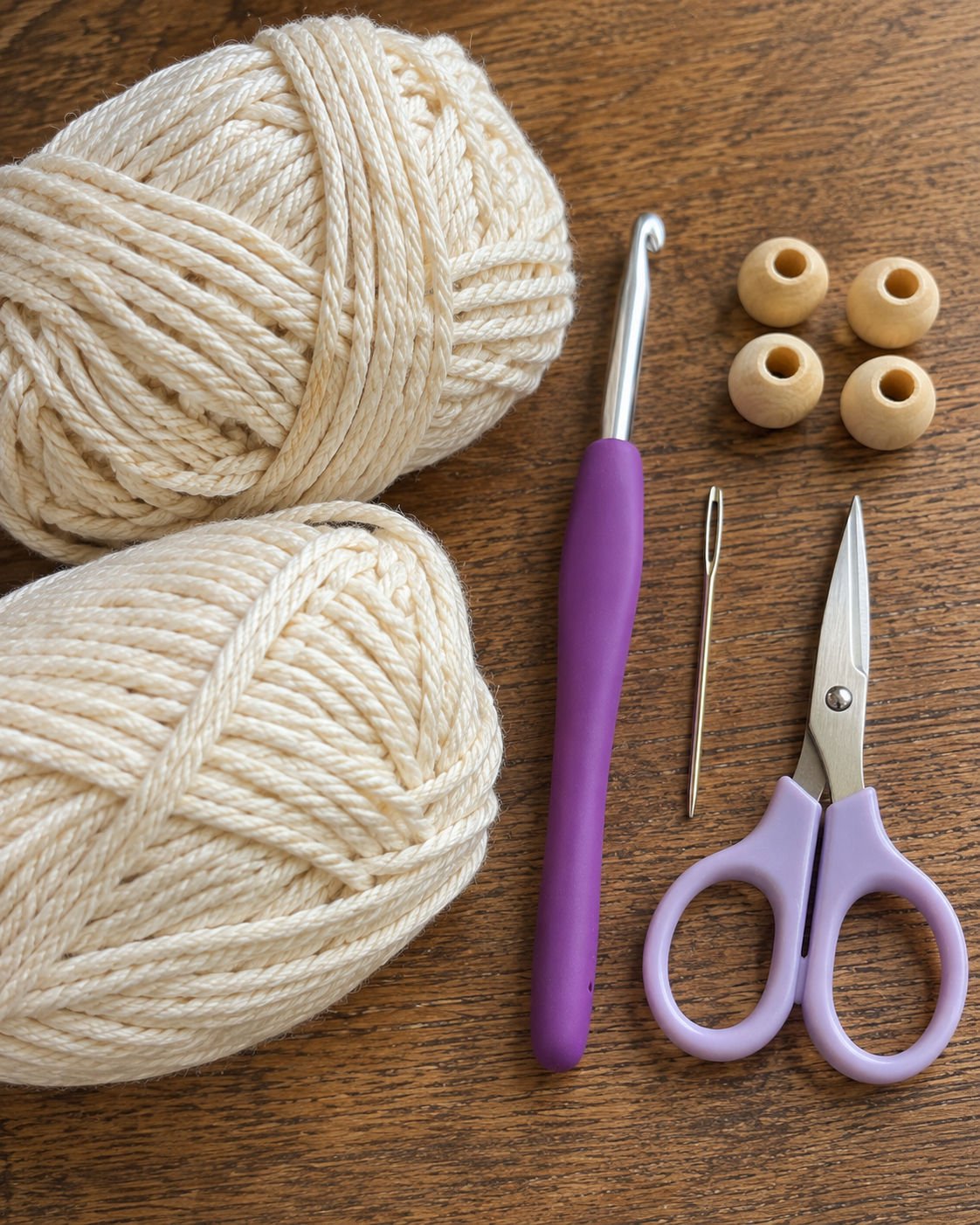
Choose a pot and plant appropriate for the yarn and hanging point. Cotton is durable and has relatively little stretch, but yarn is not a substitute for rated plant hardware. Support the pot while testing, make sure the four straps are even, and do not hang a heavy or waterlogged pot until you have checked the attachment and crochet fabric.
Abbreviations and Working Notes
-
ch = chain
-
dc = double crochet
-
ss = slip stitch
-
st = stitch; sp = space
-
yo = yarn over
Parentheses tell you how many times to repeat a group. Square brackets mean work all enclosed instructions in the same indicated stitch or space. The beginning ch 3 counts as a dc throughout. Close every round by working an ss into the top of that beginning ch-3 unless the round says otherwise. A cluster is shaped by groups of two dc separated by chain spaces; keeping those spaces open gives the hanger its light surface.
Construction Map
Both sizes begin with the same center and increase sequence. The small hanger reaches its base diameter after Rnd 4, then uses a repeatable side round. The big hanger continues through additional shaping rounds to widen the base before working its side height. In the final round, four widely spaced chain straps are made at selected chain spaces; the working yarn then returns along each strap with slip stitches. That reinforcement turns a loose chain into a more stable hanger.
Small Plant Hanger Instructions
Make a magic ring. Keep the ring loose enough to accept the first round, then pull the tail firmly after joining.
Rnd 1
Ch 3, then work 1 dc and ch 1 in the ring. Repeat (2 dc, ch 1) five times in the ring. Join with an ss to the top of the beginning ch-3 and pull the ring closed. You have 12 dc and 6 ch-1 spaces.
Rnd 2
Ss in the next dc and into the next ch-1 sp. Ch 3; in that same space work [1 dc, ch 2, 2 dc]. *Skip the next 2 dc; in the next ch-1 sp work [2 dc, ch 2, 2 dc]. Repeat from * around, omitting the final 2 dc, then join. You should have 24 dc and 6 ch-2 spaces.
Rnd 3
Ss in the next dc and into the ch-2 sp. Ch 3; in that space work [1 dc, ch 1, 2 dc, ch 1, 2 dc]. *Skip 4 dc; in the next ch-2 sp work [2 dc, ch 1, 2 dc, ch 1, 2 dc]. Repeat from * around, skip the final 4 dc, and join. The count is 36 dc and 12 ch-1 spaces.
Rnd 4
Ss in the next dc and into the next ch-1 sp. Ch 3; work [1 dc, ch 1, 2 dc] in the same space, skip 2 dc, then work [2 dc, ch 1, 2 dc] in the next ch-1 sp. *Skip 4 dc; work [2 dc, ch 1, 2 dc] in the next ch-1 sp, skip 2 dc, then work [2 dc, ch 1, 2 dc] in the next ch-1 sp. Repeat from * around, skip the last 4 dc, and join. The round ends with 48 dc and 12 ch-1 spaces.
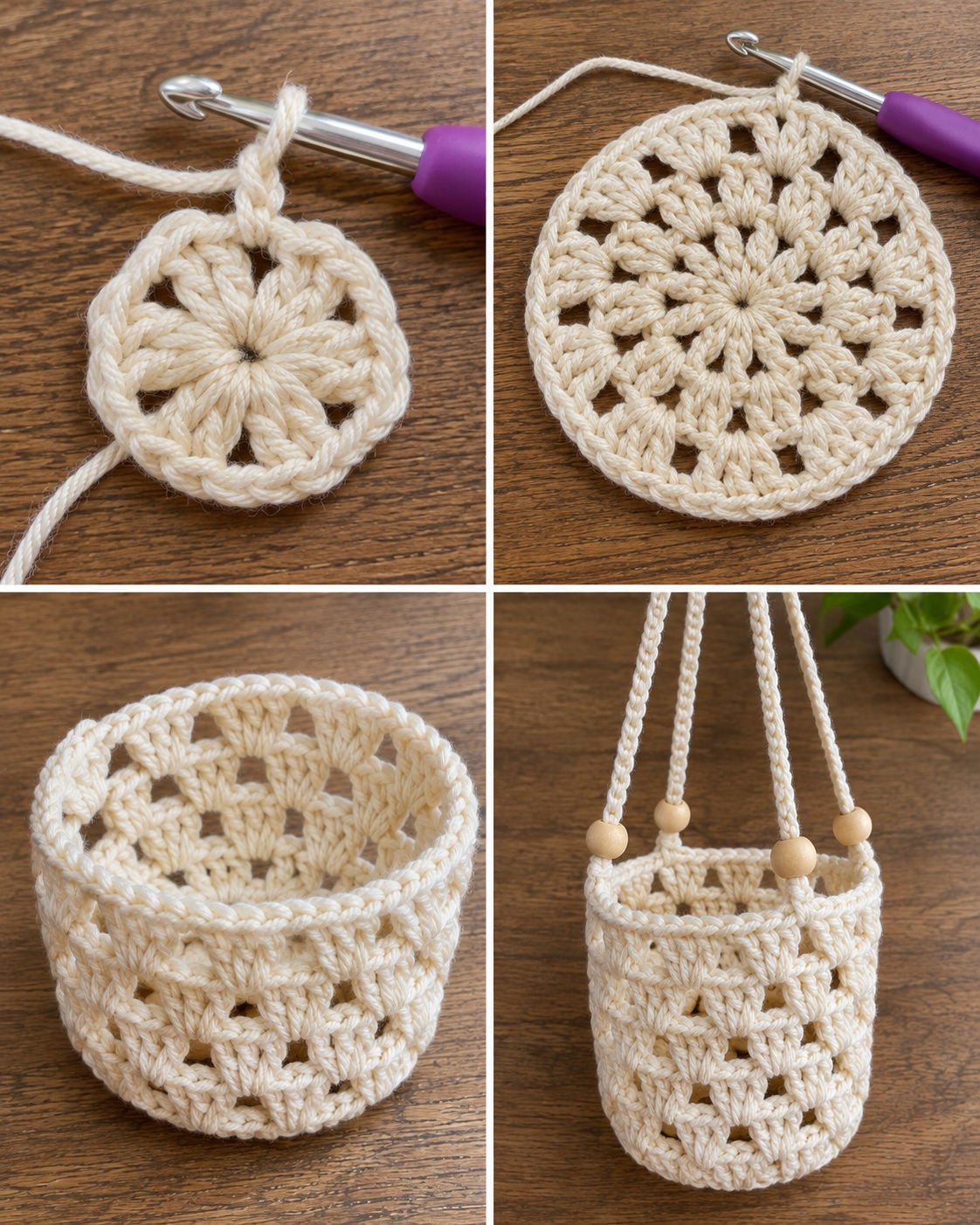
Checkpoint: After Rnd 4, the small base should lie as a round open disk about 4 inches across at the recorded gauge. If it cups sharply, check that each skipped-stitch section and chain space was worked. If it ruffles, compare the number of cluster groups with the 12 chain spaces before moving on.
Small Side Rounds
For Rnd 5, ss to the next ch-1 sp, ch 3, and work [1 dc, ch 1, 2 dc] in that same space. *Skip 4 dc and work [2 dc, ch 1, 2 dc] in the next ch-1 sp. Repeat from * around; skip the final 4 dc and join. This round keeps 48 dc and 12 ch-1 spaces. Repeat Rnd 5 seven more times, or adjust the side height to suit the pot.
Small Final Strap Round
Ss to the next ch-1 sp and ch 3. In the same space work 1 dc, ch 72, skip 8 chains, then ss into the middle loop of each of the next 64 chains; complete the cluster with 2 dc in the same space. Work the next two ordinary cluster spaces as follows: skip 4 dc, work [2 dc, ch 1, 2 dc] in the next ch-1 sp, twice. *Skip 4 dc, then make the next reinforced strap in the following ch-1 sp: [2 dc, ch 72, skip 8 ch, ss in the middle loop of the next 64 ch, 2 dc]. Follow it with two ordinary cluster spaces. Repeat from * around, skip the final 4 dc, and join. The final round has 48 dc, 12 ch-1 spaces, and 4 hangers.
Big Plant Hanger Instructions
Work Rnds 1–3 as written for the small hanger. Then use the following larger-base sequence.
Rnd 4
Work the same cluster placement and skip pattern as Small Rnd 4: begin at a ch-1 space, work the first cluster, skip 2 dc, work the next cluster, then repeat the alternating skip-4/skip-2 arrangement around. Join at the beginning ch-3. This larger pathway is recorded with 48 dc and 18 ch-1 spaces.
Rnd 5
Ss to a ch-1 sp and ch 3. In the same space work [1 dc, ch 1, 2 dc, ch 1, 2 dc]; skip 4 dc and work [2 dc, ch 1, 2 dc] in the next space. *Skip 4 dc; work the double cluster in the next ch-1 sp, skip 4 dc, then work the single cluster in the next ch-1 sp. Repeat from * around, skip the last 4 dc, and join. The round has 60 dc and 12 ch-1 spaces.
Rnd 6
Ss to a ch-1 sp and ch 3. Work [1 dc, ch 1, 2 dc] in the same space; skip 2 dc. Then repeat twice: work [2 dc, ch 1, 2 dc] in the next ch-1 sp and skip 4 dc. *Work a cluster in the next ch-1 sp, skip 2 dc, then repeat the cluster-and-skip-4 sequence twice. Repeat from * around, skip the final 4 dc, and join. You should have 72 dc and 18 ch-1 spaces.
Rnd 7 and Big Side Height
Ss to the next ch-1 sp, ch 3, and work [1 dc, ch 1, 2 dc] in the same space. *Skip 4 dc and work [2 dc, ch 1, 2 dc] in the next ch-1 sp. Repeat from * around, skip the final 4 dc, and join. The count remains 72 dc and 18 ch-1 spaces. Repeat Rnd 7 eight more times, or change the height for the chosen pot.

Checkpoint: The big basket should show evenly repeated open spaces all the way around, not a spiral or a wedge. At the end of Rnd 6, count 18 chain spaces before working the sides. If the wall leans, confirm that the beginning ch-3 was included in the join and that you slipped into a chain space before starting each round.
Big Final Strap Round
Begin at a ch-1 sp: ss into position, ch 3, and work 1 dc. Make the first reinforced strap with ch 72, skip 8 chains, and ss in the middle loop of the next 64 chains; finish with 2 dc in the same space. Work three ordinary cluster spaces, each separated by skipped dc as established. After another skipped section, make a second strap, then work four ordinary cluster spaces. Repeat that distribution for the third and fourth straps: after the third strap work three ordinary cluster spaces; after the fourth, work four ordinary cluster spaces, skip the final 4 dc, and join. The source records 72 dc, 18 ch-1 spaces, and 4 hangers.
Finishing and Hanging
Fasten off after the final join. If using beads, thread one through each hanger before arranging the loops at the hanging point. Weave the yarn ends through nearby stitches without drawing the openwork closed. Bring all four straps together, check that the base hangs level, and position the pot in the basket. A pot with a stable rim or a snug fit is easier to keep centered than a very tapered pot.
Final checkpoint: Set the empty pot into the hanger and lift it only a few inches while supporting the bottom. The four straps should share the load evenly and the pot should sit upright. If one loop is shorter, revisit the chain count and the slip-stitch return on that strap before hanging the project.
Technique Lab
-
Entering a chain space: The ss at the start of a round moves the yarn from the top of a dc into the open space where the next cluster belongs. Starting in the space keeps the cluster centered.
-
Making a dc cluster: Work the dc stitches in the indicated space, not into the chain itself. The chain between clusters creates the openwork; avoid pulling it tight.
-
Reinforcing a strap: The long chain alone is flexible. Slip stitching back through the middle loop of the following 64 chains adds a firm cord-like return path. Keep these slip stitches consistent rather than tight.
-
Checking tension: A base that is much smaller than the stated gauge can make the pot fit poorly. Adjusting hook size is a general option if fabric is consistently too tight or loose, but recheck the diameter before committing to the side rounds.
Troubleshooting
-
The center will not close: the magic-ring tail was not pulled after the first join. Pull the tail firmly, then secure it when weaving in.
-
The circle has a missing open space: a chain-1 or ch-2 gap was skipped inside a cluster. Compare the round with its stated number of spaces and repair before building height.
-
The straps do not match: one strap may not have 72 chains, or the reinforced return began after the wrong number of chains. Count the eight skipped chains and the 64 slip stitches on each strap.
-
The pot tips: the basket may be too shallow for the pot, or the straps may not be placed evenly. Add side-round repeats only where the source allows height adjustment, then recheck the four attachment points.
FAQ
Can I make the sides taller?
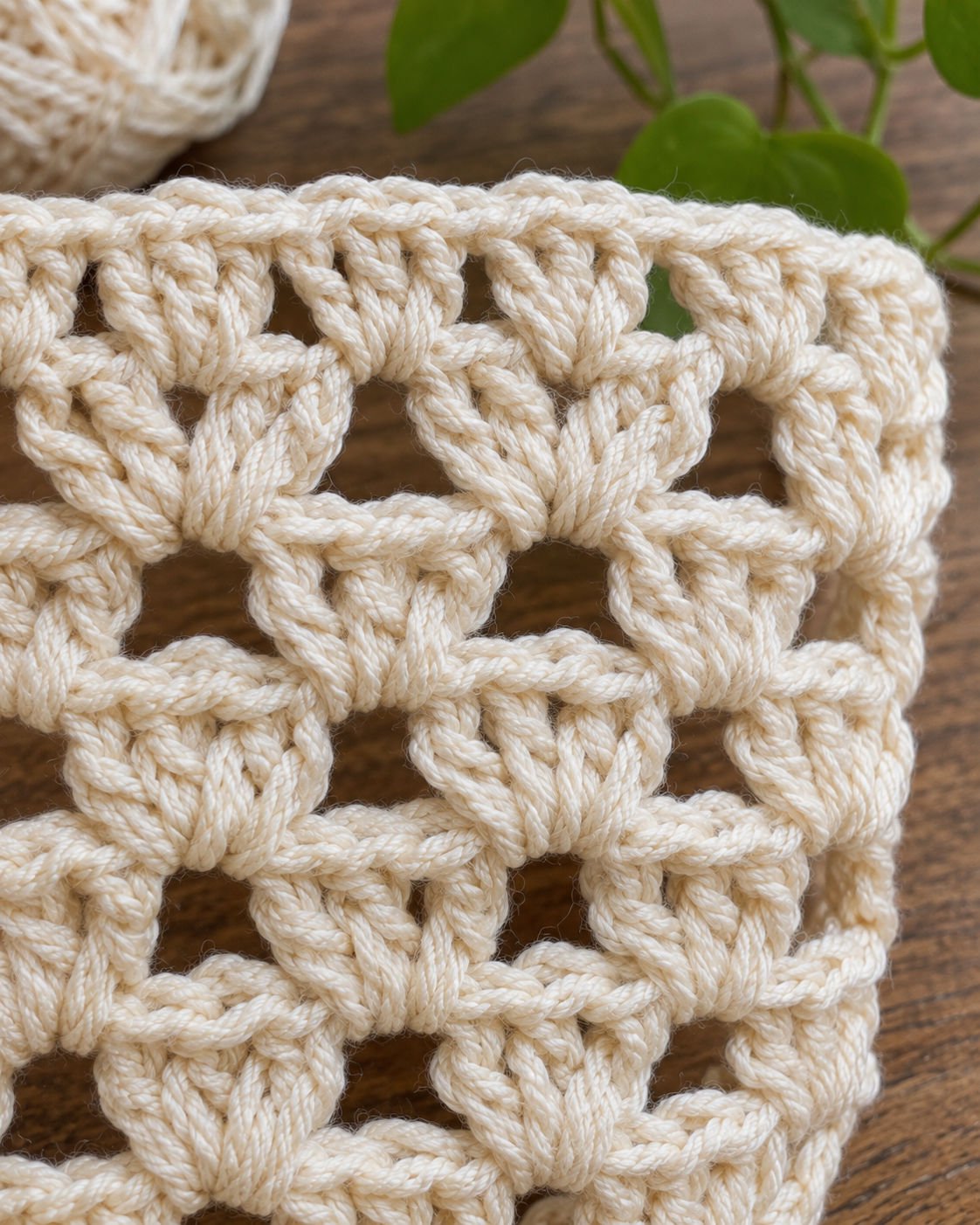
Yes. The small version repeats its side round seven additional times, and the big version repeats its side round eight additional times; both instructions also allow you to work to the height you want.
How many straps does the hanger use?
Both recorded sizes finish with four integrated hangers.
Are beads required?
No. The four beads are optional; they are simply threaded through the completed hangers.
Why use cotton yarn?
The source recommends cotton or a high-cotton blend because the fiber is sturdy, durable, and does not stretch much for this home-decor use.
Which crochet terminology does this pattern use?
The abbreviations and instructions use US terms, including dc for double crochet and ss for slip stitch.
Ready to Display
This project combines a simple round start with a repeatable openwork wall and four reinforced loops. Once the base is flat, the space count is correct, and all four straps match, you have the key checks needed for a neat functional plant hanger. Test the finished holder with care, then use it to bring a small plant into a bright corner of your home.
More in Uncategorized

How to Crochet Thermal Stitch: A Practice Swatch
How to Crochet an Amigurumi Ball in Continuous Rounds